

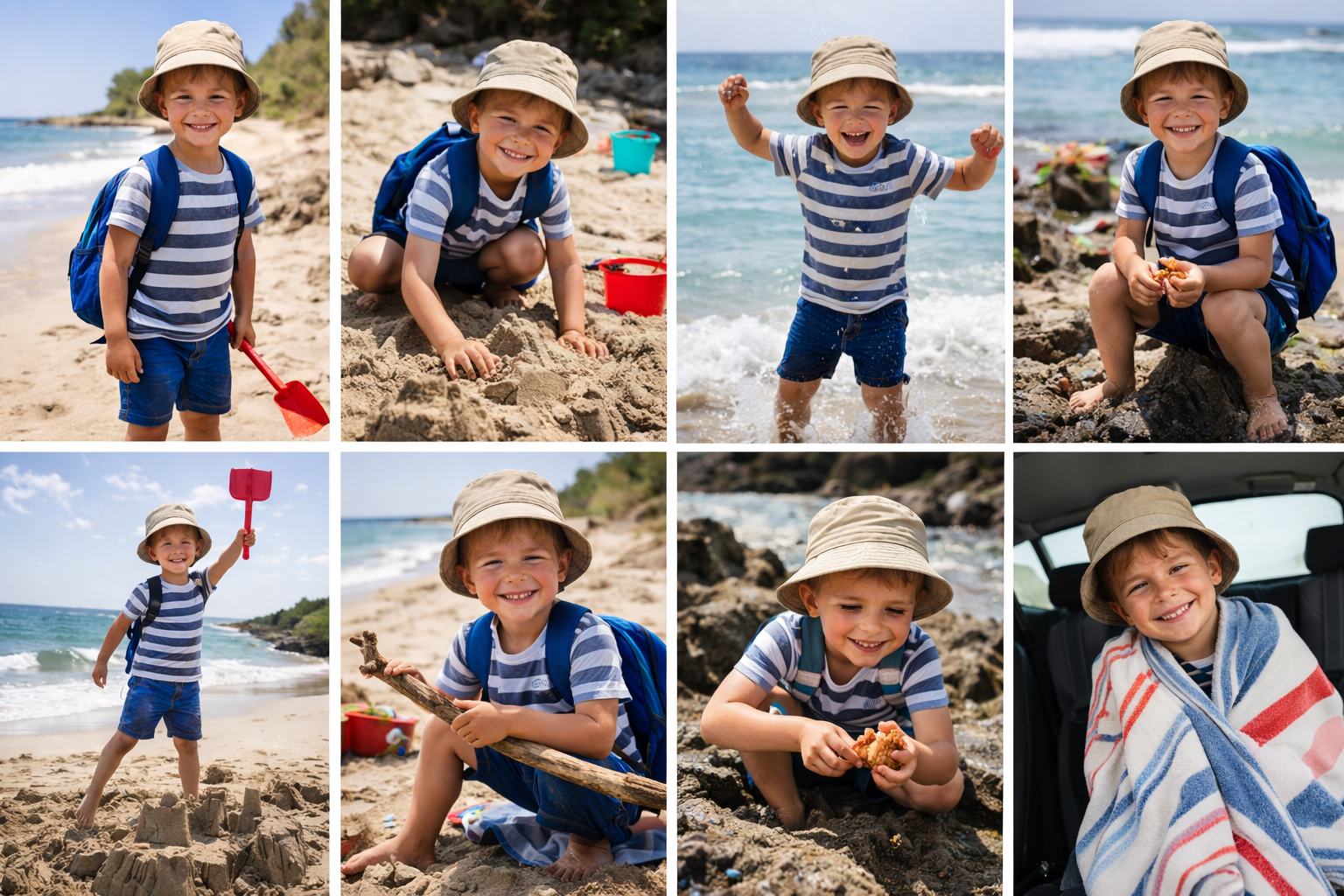
We didn’t take photos for a story.
We took them the way families always do now — without thinking too much about it.
The phone was in a pocket. Something happened. We lifted it and pressed the button.
Standing at the water’s edge.
Holding the shovel.
Looking closely at something in the sand.
Leaning out of the car window on the way there.
None of the photos were staged.
No one was told where to stand.
No one was asked to smile.
They were simply moments.
And that’s important.
Because when you look back later, you don’t need perfect pictures. You need honest ones.
A slightly crooked photo of him concentrating is better than a posed shot with a forced grin.
A picture of him choosing where to build says more than one of him being told what to do.
You don’t need dozens of photos.
Three or four is enough.
You’re not documenting everything.
You’re capturing proof.
Proof that he was there.
Proof that he decided.
Proof that he handled things.
Most of the time, you already have the material for a story sitting quietly in your camera roll.
You just haven’t looked at it that way yet.